
Supply Chains Under Pressure: Why Backup Solutions Are No Longer Optional

Global supply chains have become more complex, more interconnected – and significantly more vulnerable. Geopolitical conflicts, infrastructure disruptions, extreme weather and unexpected security incidents can interrupt established transport routes within hours. For internationally active companies, having a Plan B is therefore no longer simply an advantage. It is becoming an essential part of modern supply chain management.
For decades, global trade was built around one central principle: efficiency. Companies optimized production, inventories and transportation routes to reduce costs and shorten delivery times.
Today, another factor is becoming equally important:
resilience.
The question is no longer only:
What is the cheapest and fastest way to move goods from A to B?
Companies increasingly need to ask:
What happens if this route is suddenly no longer available?
Recent developments around the world demonstrate exactly why this question matters.
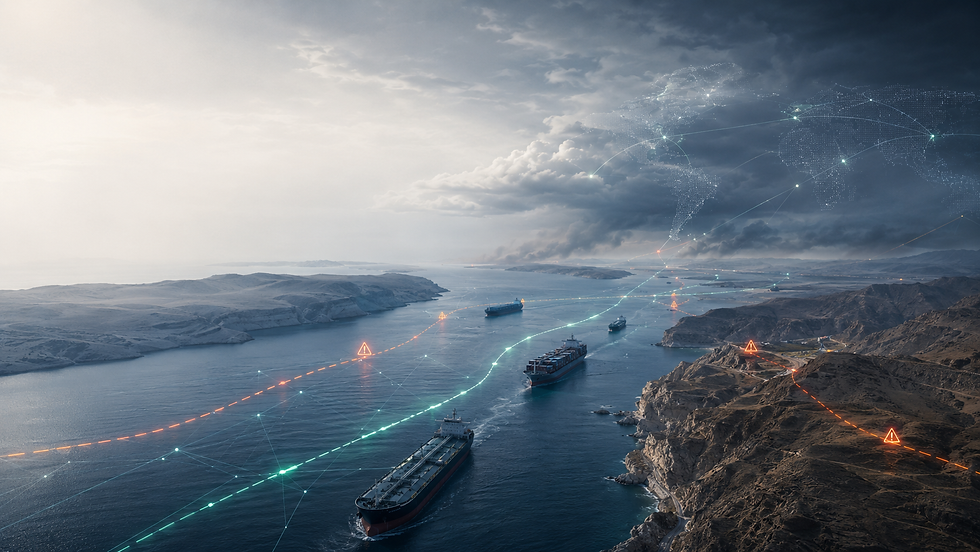
The Strait of Hormuz: When a Strategic Chokepoint Becomes a Global Supply Chain Risk
Few places demonstrate the vulnerability of international trade as clearly as the Strait of Hormuz.
The narrow waterway between Iran and Oman is one of the world's most strategically important maritime passages, particularly for energy transportation.
The ongoing conflict involving Iran, Israel and the United States has dramatically increased the risks surrounding this route. As of August 2026, shipping activity through the Strait of Hormuz remains far below pre-conflict levels while negotiations over restoring safer commercial passage continue.
What begins as a regional political or military confrontation can therefore rapidly become an international logistics problem.
The consequences extend far beyond vessels travelling directly through the region.
Disruptions can lead to:
vessels being rerouted
longer transit times
reduced shipping capacity
rising freight and insurance costs
equipment imbalances
port congestion
increasing energy and transportation costs
For importers and exporters, this demonstrates an important reality:
A supply chain can be affected by a conflict thousands of kilometres away from the actual destination of the goods.

Russia and Ukraine: Infrastructure Has Become Part of Supply Chain Risk
The war between Russia and Ukraine provides another example of how geopolitical conflicts can directly influence transportation infrastructure.
Railways are particularly important for Ukrainian domestic logistics and exports. During 2026, Ukrainian authorities reported extensive damage to railway infrastructure and locomotives resulting from Russian attacks, placing additional pressure on one of the country's most important logistics networks.
For European companies, geopolitical disruptions can also affect rail corridors, border procedures, capacity planning and the availability of alternative transportation routes.
Rail freight is often considered an attractive alternative between road, sea and air freight.
But it is still infrastructure-dependent.
If important railway lines, terminals, bridges or border crossings become unavailable, companies relying too heavily on one corridor can quickly face serious delays.
The lesson is simple:
Changing the mode of transport does not eliminate risk. It merely changes the type of risk.

Airports and Drones: Small Incidents Can Threaten Major Cargo Hubs
Modern supply chains also depend heavily on air freight – particularly for urgent goods, electronics, spare parts, medical products and high-value shipments.
But airports themselves are increasingly exposed to new types of disruption.
The importance of this risk became particularly visible at Leipzig/Halle Airport, one of Europe's major cargo hubs, when German investigators discovered a drone equipped with explosives and a detonator in August 2026. Investigators subsequently examined whether the incident could have been connected to cargo or military-related aviation activity.
Even when an individual incident does not result in a prolonged airport shutdown, it demonstrates the vulnerability of critical aviation infrastructure.
At major cargo hubs, significant disruptions can quickly create cascading effects.
Aircraft may need to be diverted, slots can disappear, cargo misses connecting flights and shipments originally scheduled through one hub may suddenly compete for capacity elsewhere.
This is the nature of modern logistics:
A local disruption can become a network-wide problem.

Low Water on the Rhine: Even Nature Can Close a Supply Chain
Not every disruption is geopolitical.
Sometimes the problem is simply water.
The Rhine remains one of Europe's most important inland transportation corridors and connects major ports such as Rotterdam and Antwerp with industrial regions in Germany, France, Switzerland and neighbouring countries.
During the summer of 2026, extremely low water levels once again demonstrated the vulnerability of inland shipping.
At the end of July, Hapag-Lloyd reported that falling Rhine water levels were significantly affecting barge operations and hinterland transportation. At Kaub – one of the most important reference points for Rhine navigation – levels approached thresholds at which parts of the Upper Rhine can become effectively unsuitable for normal inland vessel operations.
The consequences can be immediate.
Containers arriving perfectly on schedule at Rotterdam or Antwerp may suddenly be unable to continue their journey by barge as originally planned.
Companies are then forced to shift cargo to:
rail or truck transportation.
But thousands of other containers may require exactly the same solution at the same time.
Capacity becomes limited.
Prices increase.
Transit times become unpredictable.
And what appeared to be a small environmental problem suddenly affects an entire logistics network.
The Biggest Supply Chain Risk Is Having Only One Solution
These examples have very different causes.
A geopolitical conflict in the Middle East.
A war affecting railway infrastructure in Eastern Europe.
A security incident involving an airport.
Low water levels on European rivers.
Yet they all lead to the same conclusion:
Dependence on a single transportation route creates vulnerability.
Companies cannot control geopolitical developments.
They cannot control water levels.
They cannot prevent every airport closure, infrastructure failure or security incident.
But they can control how prepared their supply chain is when something happens.
That is why modern supply chain management increasingly requires backup solutions to be planned before they are needed.
Plan A Is Important. Plan B Is Essential.
A resilient supply chain should ideally have alternatives across several levels.
Alternative Transport Routes
Companies should understand which ports, airports, terminals and border crossings could replace their standard route.
If Rotterdam becomes problematic, could Antwerp be used?
If one rail corridor is interrupted, is another available?
If a barge connection becomes impossible, can containers continue by rail or truck?
These questions should be answered before disruption occurs.
Alternative Modes of Transport
Sea freight will usually remain significantly cheaper than air freight.
Rail can offer advantages over road.
Barge transportation can provide highly efficient inland connections.
But every mode has different strengths and vulnerabilities.
A strong logistics strategy therefore does not necessarily choose one transportation method.
It understands how and when to switch between them.
Alternative Suppliers
Transportation is only one part of supply chain resilience.
Companies sourcing critical products from a single supplier or a single geographic region can face similar problems.
A production interruption, export restriction, port closure or regional crisis can suddenly stop the entire supply chain.
Maintaining qualified alternative suppliers – even if they are not used for every order – can dramatically reduce this risk.
Alternative Warehousing
Strategically positioned inventory can provide another layer of security.
Instead of moving every product directly from production to the final market, regional inventory can provide companies with additional reaction time during disruptions.
For European businesses, this can mean combining international sourcing with strategically positioned stock inside Europe.
Alternative Logistics Partners
The cheapest logistics provider is not necessarily the most valuable partner during a crisis.
When established routes fail, access to different carriers, freight forwarders, trucking companies, railway operators and warehouses can become extremely important.
A strong logistics network creates options.
And options create resilience.
Supply Chain Resilience Does Not Mean Duplicating Everything
Having backup solutions does not mean operating two complete supply chains simultaneously.
That would often be unnecessarily expensive.
Instead, companies should identify their most critical dependencies.
For example:
Primary route:Shanghai → Rotterdam → Rhine barge → Switzerland
Possible backup:Shanghai → Antwerp → Rail → Switzerland
Second alternative:Shanghai → Northern Italy → Truck → Switzerland
Emergency solution for critical goods:Air freight → European cargo hub → Road transport
The backup route may initially be more expensive.
That is not the point.
The important question is whether the company knows that the route exists, understands its approximate cost and has access to the necessary partners when it is needed.
A backup solution does not need to be cheaper than Plan A.
It needs to be available when Plan A stops working.
From Just-in-Time to Just-in-Case
For many years, global companies optimized supply chains around Just-in-Time principles.
Low inventory.
Fast transportation.
Maximum efficiency.
Minimal unused capacity.
That model can work extremely well when transportation networks are predictable.
But the world has changed.
Pandemics, wars, sanctions, extreme weather, port congestion, cyber risks and infrastructure disruptions have demonstrated how quickly optimized supply chains can become fragile.
The future will therefore increasingly require a combination of two philosophies:
Just-in-Time efficiency and Just-in-Case resilience.
Successful companies will continue optimizing costs.
But they will also understand where additional inventory, alternative suppliers, multiple transportation options or diversified logistics partners provide strategic protection.
Supply Chain Management Is Becoming Risk Management
At Black Circle Switzerland, we believe international sourcing and logistics should never be viewed purely as a question of purchasing price or freight cost.
A product is only valuable when it can actually reach the market.
That means sourcing decisions must consider the complete supply chain:
supplier availability, transportation routes, geopolitical exposure, infrastructure, warehousing, customs processes and alternative solutions.
The objective is not to predict every possible crisis.
That would be impossible.
The objective is to build a supply chain capable of reacting when the unexpected happens.
Because in today's global economy, no transportation corridor should be treated as permanently guaranteed.
Businesses that prepare alternative solutions before disruptions occur gain something extremely valuable:
time, flexibility and the ability to keep moving when others are forced to wait.
And that may become one of the most important competitive advantages in global trade.
Black Circle Switzerland – Building Smarter Global Supply Chains
From international sourcing and supplier management to import, export and logistics coordination, Black Circle supports companies in building efficient and adaptable global supply chains.
Because global trade will always involve uncertainty.
The difference is how prepared your business is when conditions change.
Kommentare